Showing posts with label University of Bristol. Show all posts

Friday, 24 May 2013

Final CJII show


Yesterday afternoon our CJII team applied all they'd learnt over the last few weeks to their two half-hour radio shows on citizen journalism, the Bristol elections and Bristol's transport problems. Each show combined reports on researched topics, vox pops and live studio interviews - what an accomplishment! 

Kally and...
...Ade on air

Ujima team Roger Griffith and Paul Hassan had worked hard to help the participants understand how to structure the programmes and with additional input from David Goldlblatt, an experienced radio broadcaster himself, some essential skills were acquired on interviewing live guests.
Sibs and Ahmed interview Dr David Sweeting under the watchful eye of Roger Griffith
There were inevitably a few mistakes - unplanned re-ordering of a couple of items, some overlong pauses, a few problems with levels, all of which could have been minimised with more practice, but  these were minor drawbacks compared to the overall results of a varied, engaging and coherent pair of programmes. A good follow-on from last week's show on the Bristol Temple Quarter Enterprise Zone and satisfying way to end the project.

Jon Rogers - former Lib Deb Councillor
David Goldblatt - Broadcaster, writer and our Citizen Journalism guide
Gratified smiles after successful live broadcast from Ahmed, David Sweeting and Sibs

Wednesday, 15 May 2013

Bristol's Enterprise Zone features on live Ujima radio show

Preparation for the live discussion

After an intense scripting and production session with Roger Griffith last Thursday 9th May, the team refined the shows they've been working on and decided to distill the content into three programmes. Next week (Thursday 23rd May) there will be two half hour shows on Ujima, back to back from 16:00 - 16.30 and 16.30 - 17.00; the theme of the first will be citizen journalism and democracy in Bristol, followed by Transport in Bristol and the Bristol Bus boycott of 1963. 


Presenters Miss Divine and Sib with two of the Ujima show guests Nick Sturge and Alun Owen

But the first live programme in this CJII series went out last night when key team members of the Bristol Temple Quarter Enterprise Zone came to the studio for a an hour-long live programme. Our two presenters were from both the first CJ workshop from last year - a welcome return by Miss Divine - and Sib from our current course. The Enterprise Zone guests were Catherine Frankpitt - Senior Communications Officer; Alun Owen - Service Director of the Enterprise Zone; Alison Retter - Bristol City Council Regeneration Officer for the Zone and Nick Sturge - Managing Director of Bristol's Set Squared, an enterprise collaboration between several universities including the University of Bristol.


The presenters had devised questions covering a wide range of topics to ask the guests that included 'what is the Enterprise Zone?' 'What will it do?' 'How will inner city and disadvantaged communities get to hear about opportunities and become involved?' The citizen journalists did an excellent job - a few confusions over guests' names were minor mistakes and easily compensated for with their confidence in asking some searching questions and their deft allocation of fair time to each guest. 


All this was overseen and supported by Paul Hassan and Roger Griffith in the studio - interesting to witness the scribbling and passing of notes and sign language that enable the smooth running of a live discussion show like this that listeners don't get to see! The show was recorded and a podcast will be available soon - the link will be posted here. 

Another of the CJ team, Nas, was tasked with filming the show and some additional interviews with the guests after the show. This is a continuation of her volunteer work with Firstborn Creatives and the films also will be uploaded to the Ujima website and links posted here as soon as they're available.


The crew and guests

Friday, 3 May 2013

At the City Hall for Bristol Council election results


Inside the City Hall reporting on election results
CJ team blogging from the Council Chamber
The City Hall was a lively place this morning - a great sense of anticipation but a few anxious faces too as the results were read out in the Council Chamber. The re-arranging of this session from it's original timing of yesterday afternoon meant that only two of our team were able to be there but they had media passes and did a very fine job of covering the event for two hours through blog posts, photos, interviews and Tweets - including some interaction with University of Bristol's Alex Marsh and David Sweeting that can be seen on the @BSmayorwatch feed on the Bristol Mayor Watch blog.

Since the team had interviewed several East Bristol candidates last week at the Lawrence Hill and Easton Councillor question time event at the City Academy it made the announcement of the results seem more personal and relevant as they were already familiar with the aims and aspirations of people like Dr Jon Rogers (Lib Dem), Rob Telford (Green) and Habiq Jama (Labour).

There was much jubilation in the Chamber from Green party supporters as two candidates were voted in - Daniella Radice and Rob Telford, doubling their presence on the council. Daniella had also been the Green candidate for the Mayoral Elections in November and was interviewed by the previous CJ team on the Ujima Radio show after the elections. She agreed to be interviewed again and we hope to have her on one of the forthcoming Ujima radio programmes.
Rob Telford interviewed about his election to Ashley Ward for the Greens
Daniella Radice, Greens, gets a double interrogation after...
her election to Bishopston ward
Unfortunately we had to leave before the Lawrence Hill results were announced but understand that news of the election of Bristol's first Somali Woman, Habiq Jama, representing Labour, was received with much excitement.

Another interview our CJs had recently recorded was with Guy Poultney, in connection with planning and regeneration in the Temple Quarter Enterprise Zone. Guy is a Lib Dem and had represented Lockleaze ward for four years and was on the Council Executive, but was ousted by the Labour Candidate for that ward, Estella Tincknell. We hope to interview whoever is appointed to Guy's previous role as a member of the council committee for Development Control in the Enterprise Zone.

Announcement of Lockleaze Ward's Labour win - and Lib Dem loss.
A disappointing day for the Liberal Democrats in the election results - both Jon Rogers and Guy Poultney had been enthusiastic supporters of Ujima, along with Marvin Rees (Labour), George Gollop (Conservatives) and representatives from other parties. However, the gains and losses in the council and new cabinet appointments will all provide a good source of material for discussion on the radio programmes in the very near future.

Two of the CJ team with Ujima's Roger Griffith

Monday, 29 April 2013

At University of Bristol's School of Social Policy


Back at Bristol University's School of Social Policy again (see post about the first part of Bristol Mayor Watch project ) with Professor Alex Marsh and Dr David Sweeting to learn about how Bristol is run - the mayor, the council, the councillors. 


Pleased to see some homework has been done before the session by our citizen journalist team (they'd been sent links to profiles of Alex and Dave and to their blogs and areas of research - see links below) so there are some good questions about elections, housing and social policy in general - the responses noted and Tweeted to @BSmayorwatch.

Alex Marsh and Dave Sweeting

Now there's an elected Mayor the relationship between the Mayor and councillors will make a difference so the outcomes of the forthcoming election (next week) is a topic under scrutiny from both within and outside Bristol.
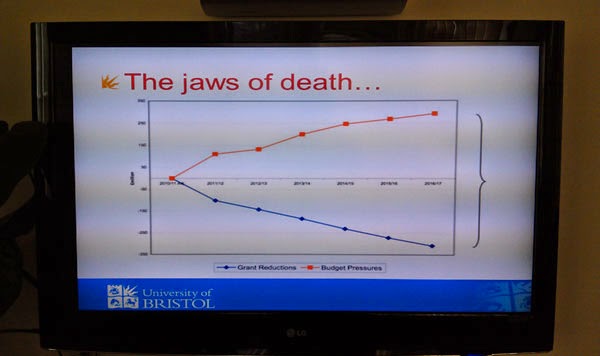
Transport is one issue that the academics have focused on for this session as it's such a hot topic in Bristol but perhaps the most revealing information was a graph known as The Jaws of Death, that clearly illustrates the huge cuts in the city's expenditure that the Mayor will have to make in the near future.


Some of the team aren't familiar with the British political system and found it a really interesting session and they'd all learned something new about Bristol's governance - the election process, what councils are and aren't responsible for, the structure of the council - one person felt the information would 'help me to develop myself more'


New insights into the hierarchies of the city were also discovered - one team member felt the amount of power the elected Mayor holds is underestimated by many, and no-one yet knows how much impact the council will have over the decisions he makes. Another of our trainees had come to understand during this session what an important role influence has within the process of implementing policy; who will have the most influence once the new councillors are elected? Well it may take some time for this to become evident but we'll be reporting on the elections from the City Hall later this week with further Tweets and blog posts by the team on the Bristol Mayor Watch blog.


These are links to information on or blogs by our excellent hosts at University of Bristol this evening, Professor Alex Marsh and Dr David Sweeting
http://www.thisisbristol.co.uk/Elected-mayor-role-bring-stability/story-15968038-detail/story.html#axzz2SG4gJpRy


Wednesday, 10 April 2013

Radio planning


Yesterday's session was held at the Ujima radio studios where most of the 3 hours was taken up with discussing content and planning the schedule for the radio show that the team will be delivering on May 9th.  However, as you can see from the previous post (and more photos below), the journalists did get a taster of live broadcasting for a 7 minute slot - little warning for them but they all responded really well, with Roger Griffith providing an outline of the project, David Goldblatt explaining the citizen journalism aspect and some of the participants talking about why they'd decided to join up.


Back round the table, Roger outlined the elements that make up most of Ujima's radio programmes, then through discussion with the team and David, each element was explained and expanded and topics for inclusion were vigorously debated - these include the appointment of Bristol's first Muslim mayor, the forthcoming local council elections and how the newly elected mayor and PCC are dealing with policing, transport and economic development and regeneration. How much of the show would be pre-recorded, what subjects would provide good vox pops material and who would be ideal to have as live guests on the show were also part of the conversation.


The result of all the talking was a good collection of potential material but further editing and refinement will be needed over the next few weeks, possible guest speakers must be contacted and decisions made about whether to do more than one programme. Parallel tasks will see each team member researching their selected topics and devising interview questions for a visit to University of Bristol academics with an interest in these fields.


During the course of the session each participant worked on a 'programme clock' (a pie-chart diagram of the radio show) with frequent amendments, additions and deletions along the way. But at the end of the session, with a growing sense of enthusiasm everyone had achieved a 'work in progress' clock chart and for many of the participants a much better understanding of how a radio programme is put together. One of the team said -
"This is my first time [planning a radio show] - it's a … challenge for me, a good challenge. I'm thinking it's something I can go forward to study, I really enjoyed it. I hope that by the end of it I will gain a lot of experience which will really help me as well to build up my own confidence…. I'm kind of shy but I think with this it's going to bring me out of my shell!" 


First time in the studio for the Citizen Journalism team at Ujima Radio.

Tuesday, 9 April 2013

Surprise broadcast opportunity!


Throwing our citizen journalists in at the deep end - Roger Griffith arranged for them to have a quick intro to live radio on Ujima's Drive Time show where the team introduced themselves and talked about why they'd decided to take part in the project, they did well!


Thursday, 4 April 2013

The 'mayor' and 'PCC' get a grilling from the trainee journalists


'Sue Mountstevens' and 'Mayor George Ferguson' get a grilling from the team

The highlight of the second session of MayorWatch part 2 on Tuesday was having some allegedly high profile 'guests' at our venue for the day, the Pervasive Media Studio, who agreed to be be subjected to questioning about their actions by our citizen journalist team. The 'guests' were actually our own David Goldblatt and Paul Hassan who took on the remarkably convincing roles of respectively George Ferguson, Bristol's first elected Mayor (without the trademark red trousers), and Sue Mountstevens, the Police Crime Commissioner (PCC) elected at the same time as the Mayor.

This interview session took place after our participants learned how to effectively track down useful sources of information on the internet about their subjects, assess what they found and begin to find topics that they felt needed some fleshing out by the 'Mayor' and the 'PCC'. This research and the subsequent development of useable interview questions was guided by David Goldblatt and Paul Hassan (before they transformed!) and Roger Griffith who also conducted the interview process. Roger invited the interviewers to ask their questions, the 'guests' would reply and the journalists would then come back with a second question - something that they had prepared but that should also respond to points made by the guests. During the debate Roger would ask the journalists to pause at certain points and think whether they'd been given the information they's asked for, consider asking the questions in a different way, and remind them to keep focused. 

This procedure provided some very valuable insights into the successes and weaknesses of the interviews so the trainee journalists began to see how they could approach a topic from a different angle; should only contest a statement by their interviewee if it can backed up by appropriate statistics or facts; ask carefully focused questions that could deter interviewees from providing generic information, and keep on track with their responses. The group learned that active listening is as crucial a part of interviewing as asking the questions. 

Next week's session will be at Ujima Radio where the young journalists will begin to plan their radio programme and have some technical training in the studio. We'll also introduce them to using Twitter (we're @BSmayorwatch) and prepare some content for the forthcoming blog.


Each participant told us at least one thing they'd learnt in the session:

Transcript:
  • How to ask effective questions
  • I learnt more in depth about what's going on around me, I didn't really know much about the police crime commissioner and that but I learnt quite a bit in the research and look forward to doing some more research into it.
  • What plans are actually going towards transport and what the Mayor is planning to do about it
  • I've learnt about the environment - transport, the buses, cycling 
  • Research - being able to fact-find as opposed to just having your own theories, I guess it's empowering tools to know what people are saying, what they're doing, what's written out - documents.
  • I learnt about the Bristol Enterprise Zone, and the Bristol Green Capital and the Bristol Pound. And I learnt about active listening and also different interview techniques and how to better interview the interviewee.

Wednesday, 27 March 2013

First session of 'MayorWatch 2' citizen journalism project


The first, introductory session of our latest Citizen Journalism 'News from Elsewhere' project took place at St Paul's Family Learning Centre on Tuesday evening (26 March 2013). This is a follow up to the Bristol Mayor Watch project last year where a group of young people tracked the process of Bristol's first Mayoral election. It's the same partnership as last time between Watershed, Ujima Radio and David Golblatt with, once again, welcome financial support from the University of Bristol, but also from Bristol Temple Quarter Enterprise Zone. This time we're looking at what the Mayor, and the newly elected Police and Crime Commissioner, have been doing in their first 150 days in office, with a focus on some selected themes - more on this later.

Eight young participants, recruited by Caroline Oldland at Ujima Radio, have decided to join this new course because they are interested - in different ways - in local issues that affect them and their communities and are keen to learn how make their voices heard through the range of journalism tools we're going to guide them through over the next 8 weeks.

To introduce citizen journalism David Goldblatt showed the group some eye-opening films from You Tube made by people across the the world using, often surreptitiously, mobile phones - films that exposed vote rigging, corruption and the perfidious politics of Mitt Romney

Roger Griffith from Ujima radio outlined the themes the group will be working with during this project which include the local elections in May, the appointment of Bristol's first Muslim Lord Mayor and the Bristol Temple Quarter Enterprise Zone. In addition to generating content for the blog, the participants will be producing their own live radio programme on Ujima towards the end of the 8 weeks where they will interview local politicians live in the studio (as their predecessors did in the last project). The participants  will also collect material for podcasts during the course, this will include interviews with academics from University of Bristol who specialise in the areas we're covering in this project.

One major challenge for the project has been the news that Posterous - the excellent blogging platform we've been using for all our citizen journalism projects over the last 2 years - is closing down on April 30th after being taken over by Twitter a year ago. We've done a lot of research into blogs that will do the same thing, working with group contributors, with the ease and grace that Posterous offered, but unfortunately have found nothing free and off the shelf that effectively handles our requirements - mainly group contributions via mobile e-mail, good image displays and media embedding. So we've had to squeeze some money out of our budget to pay a pittance to a friendly Wordpress devotee to customise something for us, we'll post the link as soon as it's ready.

Meanwhile we'd hoped to carry on with the Posterous blog (backing it up) as ong as we could but it's stopped being fully functional, no e-mailed posts from mobiles are showing up and only some posts from desktops are appearing. Very disappointing Twitter.

Wednesday, 9 January 2013

Welcome to News from Elsewhere


Watershed in Bristol began running citizen journalism (CJ) workshops for young people in March 2010 in collaboration with writer, educator and broadcaster David Goldblatt. The workshops were part of the four-year long 'RELAYS at Watershed' programme that led up to the London 2012 Olympic and Paralympic Games. Over 18 months we ran eight CJ projects with 70 young people who used smartphones to report on topics ranging from Paralympian athletes training in Bath to a unique cultural quarter in Bristol - and all things Olympic in Weymouth.

'RELAYS at Watershed' has come to an end now but we're continuing with the citizen journalism strand of work under the name of News from Elsewhere and are about to start 2013 with a new action research project supported by the University of Bristol and working with Ujima Radio, David Goldblatt and staff from the University.

This follows on from a pilot scheme 'Bristol Mayor Watch' where a group of young people used smart phones to cover several aspects of the first election for a Mayor in Bristol and concluded the process with a live broadcast on Ujima interviewing several of the Mayoral candidates.

This new blog is a continuation of the 'RELAYS at Watershed' citizen journalism blog and is for documenting the progress of the new citizen journalism work we're planning.  This is where we'll report on our future projects - who was was involved, how we ran the workshops, successes, and what might change next time.

Additional blogs by the citizen journalist participants will be created for each of the projects we work on and links to those will be added to this blog.